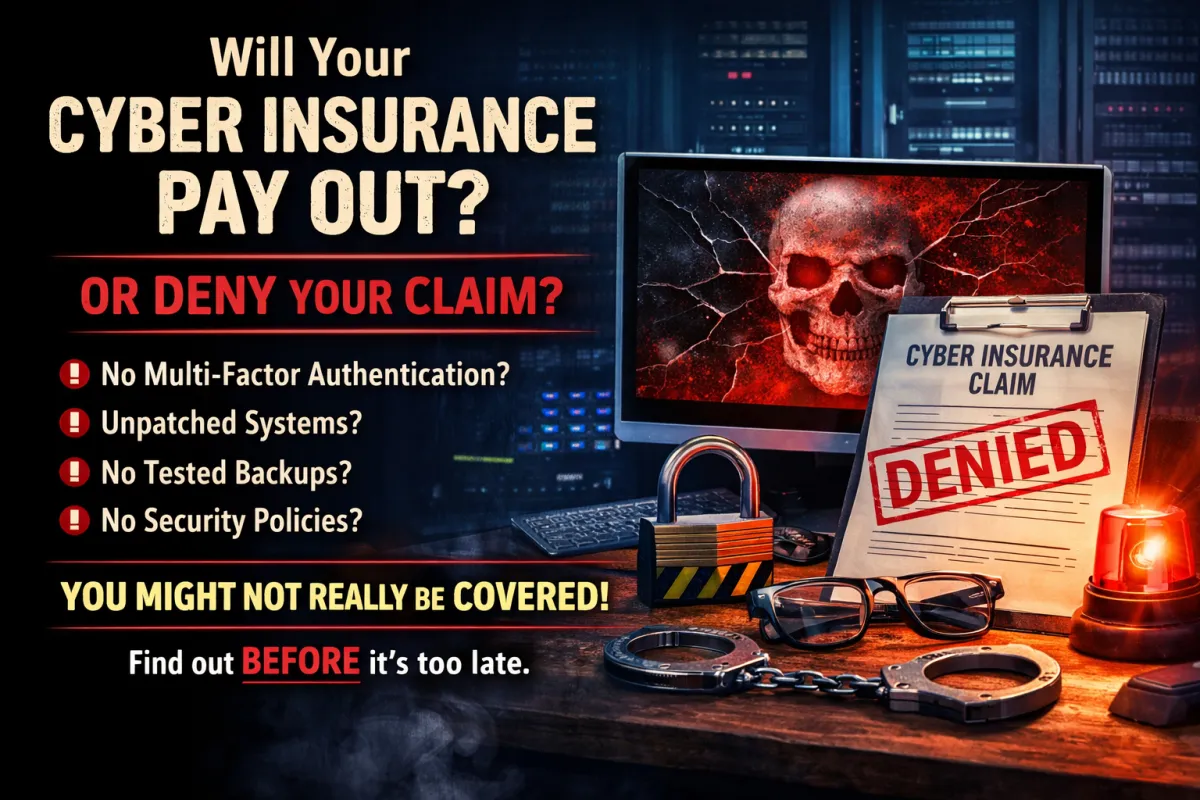
Will Your Cyber Insurance Actually Pay Out When You Need It?
Most business owners feel a sense of relief once they buy cyber insurance.
They think, “If something happens, we’re covered.”
But here’s the uncomfortable truth: having cyber insurance does not guarantee you’ll get paid after an incident.
In fact, more and more claims are being delayed, reduced, or outright denied—not because the business didn’t have a policy, but because they didn’t meet the security requirements written into it.
And many business owners don’t find that out until after they’ve been hit by ransomware, a breach, or a major outage.
Cyber Insurance Has Changed (Quietly)
A few years ago, cyber insurance was easier to get and easier to use. Today, insurers are tightening the rules—and for good reason. Claims have exploded, and insurers now want proof that you’re doing the basics to protect your business.
Most policies now require things like:
Multi-factor authentication (especially on email and admin accounts)
Up-to-date systems and patching
Proper antivirus / endpoint protection
Working, tested backups
Basic security policies and controls
Ongoing IT maintenance and monitoring
Miss some of these, and your insurer may argue that you were negligent or non-compliant—which can put your payout at risk.
In plain English: the policy only works if your IT is in order.
The Real Risk: Thinking You’re Covered When You’re Not
This is the part that keeps business owners up at night after an incident:
The attack happens
You file the claim
The insurance company asks for proof of your security controls
Gaps start showing up
The claim gets delayed, reduced… or denied
Suddenly, the “safety net” you were counting on isn’t there—and now you’re paying for recovery, downtime, lost data, and reputation damage out of pocket.
It’s like having a parachute that only works if it was packed correctly—but nobody ever checked it before you jumped.
What Insurers Actually Want to See
While every policy is different, most insurers are looking for a few consistent things:
Email security and MFA to reduce phishing and account takeovers
Reliable, tested backups to recover from ransomware
Patched and supported systems to close known vulnerabilities
Basic security controls and monitoring to show you’re not ignoring risk
Documentation and process to prove this isn’t just “set it and forget it”
This doesn’t mean you need enterprise-level complexity. It does mean you need intentional, managed IT instead of reactive, break-fix support.
Where Most Small Businesses Fall Short
In our experience at My Computer Guy LLC, most small businesses:
Have backups, but haven’t tested restores
Have MFA on some things, but not the critical ones
Haven’t reviewed insurer requirements in years
Don’t have documentation showing what’s in place
Rely on “it’s probably fine” instead of “we know it’s compliant”
None of that shows up on a normal day. It only shows up when something goes wrong—and by then, it’s expensive to discover.
The Smart Move: Verify Before You Need It
The goal isn’t fear. It’s certainty.
A proper cyber insurance readiness review helps you:
See where you stand vs. insurer requirements
Close the gaps before they become claim problems
Reduce your real-world risk of an incident
Make your coverage actually work when you need it
Sleep better knowing you’re not betting the business on assumptions
This is exactly why we focus on proactive IT management, security, and documentation—not just fixing what breaks.
How My Computer Guy
Helps
We help small businesses move from “I think we’re covered” to “I know we’re covered.”
That means:
Reviewing your current setup against real insurer expectations
Fixing the practical gaps (without overcomplicating things)
Putting protections in place that actually stay in place
Keeping your systems secure, maintained, and defensible
Making sure your cyber insurance is a tool, not a false sense of security
The Bottom Line
Cyber insurance is important—but it’s not magic.
If your IT and security don’t meet the requirements, your policy may not protect you when it matters most.
The smart time to find out is before there’s an incident.
If you’d like, we can walk you through where you stand, what needs tightening up, and what the simplest path forward looks like—for your business, your budget, and your peace of mind.
